
You are renting a
forward deployed engineer.
The term comes from defense and AI-lab engineering teams. A forward deployed engineer does not sell you software and leave. They deploy into the engagement, sit with the people doing the work, learn the domain, and build against the actual workflow. The last mile is the whole job.
I do not take the relationship
I deploy into the engagement. The client is yours before, during, and after.
I write production code, not recommendations
There is no discovery deliverable to sell before anything gets built.
How to Bring Me Work
Send me the client's problem in their own words. That is the whole intake.
Send the client's own words
Their description of the problem, in their language, by email or LinkedIn. No brief to write, no scoping call to schedule first.
I come back with fit and cost
Whether it is a fit, what it would cost, and what I am not the right fit for. You get a number before you quote your client.
You decide what the client sees
You decide how the client hears about me, or whether they hear about me at all.
Why the Economics Work at This Price
What custom software costs today
Agencies quote custom builds at $20,000 to $85,000 upfront. A first in-house developer runs about $120,000 a year. I charge a flat monthly fee with no upfront cost to the client.
Why that number holds
I build on my own framework, so every capability gets built once and every client I host gets it. Your client pays for integration, not invention. One client has had exactly this in production for two years. Website work and custom-application work are priced differently.
The no-upfront part is what makes this sellable for you. It removes the largest objection to custom software before you have to handle it.
What You Can Hand Off
The work your client asks for that you cannot sell today
A process nobody owns
Spreadsheets, an Access database, or somebody's head, built into a real system.
A custom internal tool
Client portal, inventory, case management, scheduling, quoting, billing.
A site that beats a template
Wired to whatever the business actually runs on, not a theme with the logo swapped.
AI on the client's own data
Answers from their documents, drafts of the paperwork they assemble by hand. Not content generation.
What I Will Tell You I Am Not the Right Fit For
- Anything that is genuinely a design engagement.
- Anything that needs a team on site full time.
- Anything where the client's real problem is a decision nobody has made yet.
Naming at least one "not this" is the practice, because every vendor you have talked to said yes to everything.
Structures
Pick the one that matches how you want to hold the client
White-label
I build and maintain under your brand. You charge your client what makes sense and pay my flat rate. You keep the difference every month.
Fits: design and marketing agencies. You stay the only vendor the client sees.
Revenue share
You introduce me directly. You take a recurring cut for as long as the client stays.
Fits: MSPs. You keep your own lane and still get paid for the referral.
Referral bonus
A flat one-time payment on a closed introduction.
Fits: consultants and anyone who refers occasionally rather than regularly.
Scope, Stated Plainly
Scope arguments are what kill white-label arrangements, so it is written down before the first one
Included in the monthly fee
The build, hosting, monitoring, security updates, and content edits. When your client hits new busywork, a short conversation scopes it, and each new feature is quoted before it is built.
Scoped in a design doc
Major new features, a second application, and complex third-party integrations. A complete working site is still included. The work beyond it is quoted phase by phase in a design document and spec. You see those numbers before your client does.
Design-Forward, Not Just Functional
When the client-facing site is the deliverable, it gets the same treatment as the internal tooling.
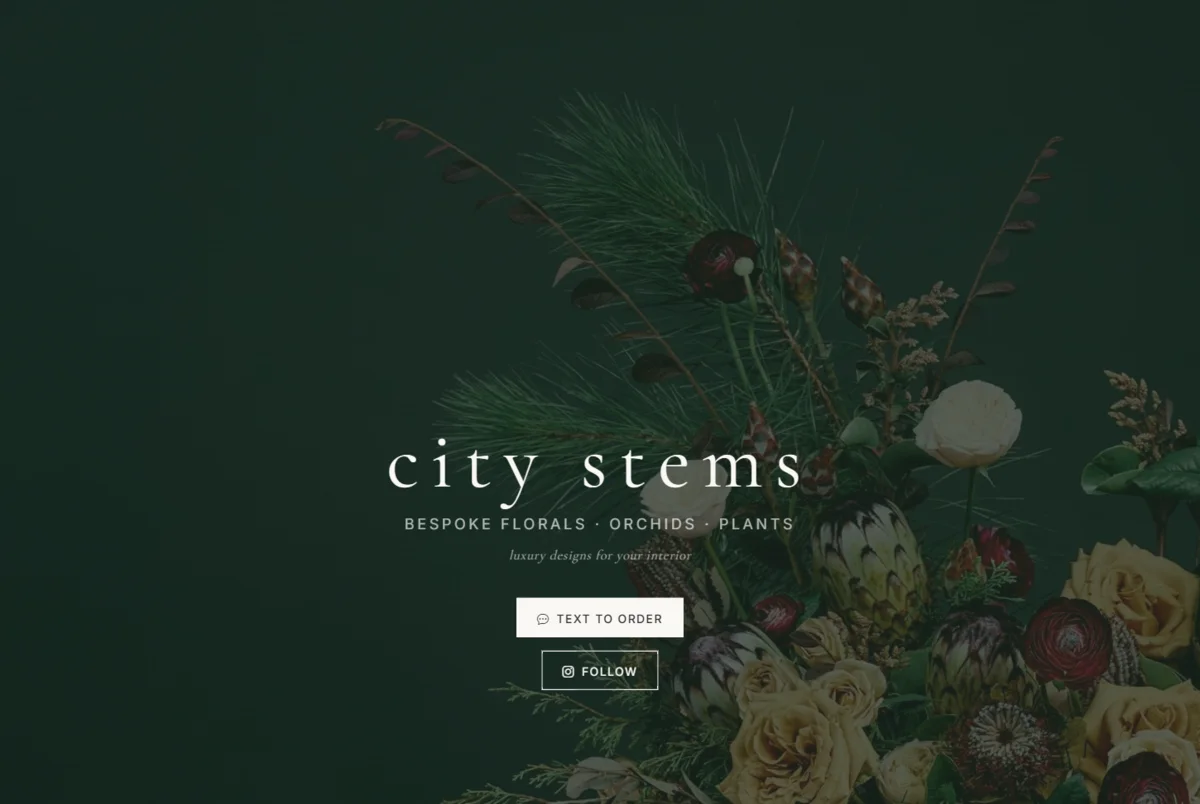
City Stems — a luxury florist website with Instagram integration and text-to-order
The Stack Your Client Inherits
Every app runs on .NET and Azure — the same stack behind Xbox Live, Stack Overflow, and thousands of Fortune 500 systems. My framework is ordinary .NET, not a proprietary runtime, so any .NET developer could pick the codebase up tomorrow.
Send Me the First One
I'm Mike — the developer behind every Hurrah.dev project, with 25+ years building enterprise software. There is no form and no process. Forward me a client's complaint and I will tell you whether I can build it.
Or find Hurrah.dev on LinkedIn
No NDAs to sign. No commitment. Just a conversation.